<p><a rel="lightbox" href="https://framearch.co.uk/t5/wp-content/uploads/2007/05/4_20_Romans.jpg"><img loading="lazy" decoding="async" class="alignnone size-medium wp-image-476" title="Roman settlement and landscape" src="https://framearch.co.uk/t5/wp-content/uploads/2007/05/4_20_Romans-580x435.jpg" alt="" width="580" height="435" srcset="https://framearch.co.uk/t5/wp-content/uploads/2007/05/4_20_Romans-580x435.jpg 580w, https://framearch.co.uk/t5/wp-content/uploads/2007/05/4_20_Romans-200x150.jpg 200w, https://framearch.co.uk/t5/wp-content/uploads/2007/05/4_20_Romans.jpg 800w" sizes="(max-width: 580px) 100vw, 580px" /></a><br />
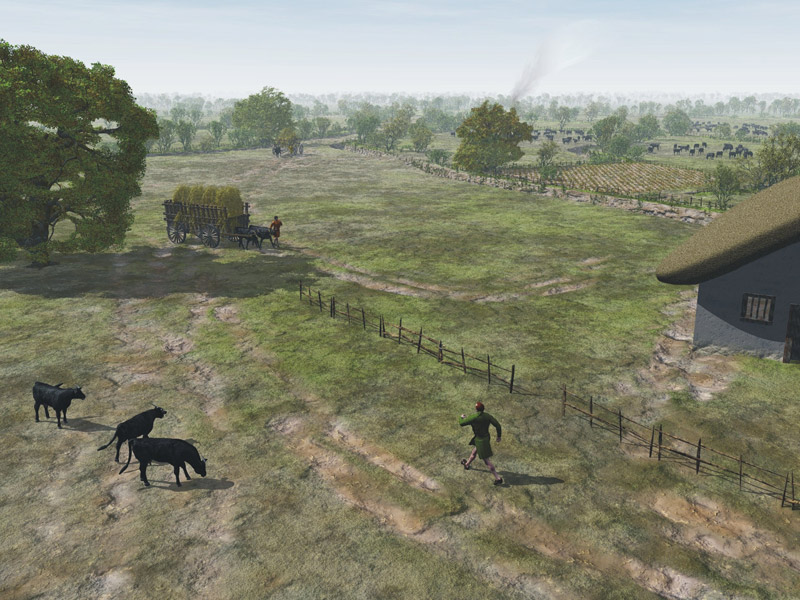
Roman settlement and landscape<span class="caption">.</span></p>
<div style="padding: 0px 0px 0px 5px; margin: 0px 0px 0px 0px;"><img loading="lazy" decoding="async" class="noborder" usemap="#Map" src="https://framearch.co.uk/t5/wp-content/images/time-nav-master.jpg" alt="Travel in time" width="490" height="39" />&nbsp;</p>
<map id="Map" name="Map">
<area shape="rect" coords="4,0,202,32" href="https://framearch.co.uk/t5/2007/04/16/400-100-bc-the-middle-iron-age-settlement/" />
<area shape="rect" coords="291,2,480,30" href="https://framearch.co.uk/t5/2007/04/24/ad-360-3-the-lead-tank/" alt="Forwards in time to 3,300-2,600 BC" /> </map>
</div>
<p>From 100 BC (Late Iron Age) the people of southern Britain came into increasing contact with the Roman Empire, culminating in AD 43 with the Roman invasion of Britain. For the next 370 years Britain became tied into the political and economic structure of the Roman Empire. At Heathrow, the old Middle Iron Age settlement became a focal point for continuing occupation through into the later Iron Age and early Roman period, although parts of the landscape were radically altered at this time, with new alignments of field systems largely overwriting the previous land divisions. While animal husbandry remained a fundamental part of the agricultural economy, the evidence suggests an increasing emphasis on cereal crops from the Late Iron Age onwards. The settlement complex appears to have been continually modified on a somewhat <em>ad hoc</em> basis throughout the Roman period, and would have undoubtedly become an integral part of the emerging Roman economy, with trackways being cut across the ancient landscape to serve the new markets at nearby Staines and the growing city of <em>Londinium.</em></p>
<p>During the later Roman period (from the 3rd century AD) radically new styles of structure and wholesale changes to the eastern field systems were introduced, resulting in a substantial ‘ladder’ enclosure system, surrounding a major central droveway, designed to accommodate high levels of livestock traffic. The impetus for such development was probably commercial, perhaps driven by wealthy estate owners to maximise profits in a steadily changing economic environment. Farms like the one at Terminal 5 may have been incorporated into large managed agricultural estates (<em>latifundia</em>), perhaps belonging to the owners of more remote villas and/or wealthy townhouses in London. Rural farmers on these estates may have become <em>coloni</em>, essentially subsistence workers who were tied to the land in service of the estate, though also able to produce a meagre surplus for themselves.</p>{"id":99,"date":"2007-05-24T10:23:17","date_gmt":"2007-05-24T10:23:17","guid":{"rendered":"http:\/\/www.framearch.co.uk\/t5\/2007\/05\/24\/roman-barn\/"},"modified":"2011-03-28T09:12:56","modified_gmt":"2011-03-28T09:12:56","slug":"100-bc-360-ad-a-new-direction","status":"publish","type":"post","link":"https:\/\/framearch.co.uk\/t5\/2007\/05\/24\/100-bc-360-ad-a-new-direction\/","title":{"rendered":"100 BC-400 AD A New Direction"},"content":{"rendered":"<p><a rel=\"lightbox\" href=\"https:\/\/framearch.co.uk\/t5\/wp-content\/uploads\/2007\/05\/4_20_Romans.jpg\"><img loading=\"lazy\" decoding=\"async\" class=\"alignnone size-medium wp-image-476\" title=\"Roman settlement and landscape\" src=\"https:\/\/framearch.co.uk\/t5\/wp-content\/uploads\/2007\/05\/4_20_Romans-580x435.jpg\" alt=\"\" width=\"580\" height=\"435\" srcset=\"https:\/\/framearch.co.uk\/t5\/wp-content\/uploads\/2007\/05\/4_20_Romans-580x435.jpg 580w, https:\/\/framearch.co.uk\/t5\/wp-content\/uploads\/2007\/05\/4_20_Romans-200x150.jpg 200w, https:\/\/framearch.co.uk\/t5\/wp-content\/uploads\/2007\/05\/4_20_Romans.jpg 800w\" sizes=\"(max-width: 580px) 100vw, 580px\" \/><\/a><br \/>\nRoman settlement and landscape<span class=\"caption\">.<\/span><\/p>\n<div style=\"padding: 0px 0px 0px 5px; margin: 0px 0px 0px 0px;\"><img loading=\"lazy\" decoding=\"async\" class=\"noborder\" usemap=\"#Map\" src=\"https:\/\/framearch.co.uk\/t5\/wp-content\/images\/time-nav-master.jpg\" alt=\"Travel in time\" width=\"490\" height=\"39\" \/>&nbsp;<\/p>\n<map id=\"Map\" name=\"Map\">\n<area shape=\"rect\" coords=\"4,0,202,32\" href=\"https:\/\/framearch.co.uk\/t5\/2007\/04\/16\/400-100-bc-the-middle-iron-age-settlement\/\" \/>\n<area shape=\"rect\" coords=\"291,2,480,30\" href=\"https:\/\/framearch.co.uk\/t5\/2007\/04\/24\/ad-360-3-the-lead-tank\/\" alt=\"Forwards in time to 3,300-2,600 BC\" \/> <\/map>\n<\/div>\n<p>From 100 BC (Late Iron Age) the people of southern Britain came into increasing contact with the Roman Empire, culminating in AD 43 with the Roman invasion of Britain. For the next 370 years Britain became tied into the political and economic structure of the Roman Empire. At Heathrow, the old Middle Iron Age settlement became a focal point for continuing occupation through into the later Iron Age and early Roman period, although parts of the landscape were radically altered at this time, with new alignments of field systems largely overwriting the previous land divisions. While animal husbandry remained a fundamental part of the agricultural economy, the evidence suggests an increasing emphasis on cereal crops from the Late Iron Age onwards. The settlement complex appears to have been continually modified on a somewhat <em>ad hoc<\/em> basis throughout the Roman period, and would have undoubtedly become an integral part of the emerging Roman economy, with trackways being cut across the ancient landscape to serve the new markets at nearby Staines and the growing city of <em>Londinium.<\/em><\/p>\n<p>During the later Roman period (from the 3rd century AD) radically new styles of structure and wholesale changes to the eastern field systems were introduced, resulting in a substantial \u2018ladder\u2019 enclosure system, surrounding a major central droveway, designed to accommodate high levels of livestock traffic. The impetus for such development was probably commercial, perhaps driven by wealthy estate owners to maximise profits in a steadily changing economic environment. Farms like the one at Terminal 5 may have been incorporated into large managed agricultural estates (<em>latifundia<\/em>), perhaps belonging to the owners of more remote villas and\/or wealthy townhouses in London. Rural farmers on these estates may have become <em>coloni<\/em>, essentially subsistence workers who were tied to the land in service of the estate, though also able to produce a meagre surplus for themselves.<\/p>","protected":false},"excerpt":{"rendered":null,"protected":false},"author":1,"featured_media":0,"comment_status":"open","ping_status":"open","sticky":false,"template":"","format":"standard","meta":{"footnotes":""},"categories":[60],"tags":[9,11,45],"_links":{"self":[{"href":"https:\/\/framearch.co.uk\/t5\/wp-json\/wp\/v2\/posts\/99"}],"collection":[{"href":"https:\/\/framearch.co.uk\/t5\/wp-json\/wp\/v2\/posts"}],"about":[{"href":"https:\/\/framearch.co.uk\/t5\/wp-json\/wp\/v2\/types\/post"}],"author":[{"embeddable":true,"href":"https:\/\/framearch.co.uk\/t5\/wp-json\/wp\/v2\/users\/1"}],"replies":[{"embeddable":true,"href":"https:\/\/framearch.co.uk\/t5\/wp-json\/wp\/v2\/comments?post=99"}],"version-history":[{"count":116,"href":"https:\/\/framearch.co.uk\/t5\/wp-json\/wp\/v2\/posts\/99\/revisions"}],"predecessor-version":[{"id":478,"href":"https:\/\/framearch.co.uk\/t5\/wp-json\/wp\/v2\/posts\/99\/revisions\/478"}],"wp:attachment":[{"href":"https:\/\/framearch.co.uk\/t5\/wp-json\/wp\/v2\/media?parent=99"}],"wp:term":[{"taxonomy":"category","embeddable":true,"href":"https:\/\/framearch.co.uk\/t5\/wp-json\/wp\/v2\/categories?post=99"},{"taxonomy":"post_tag","embeddable":true,"href":"https:\/\/framearch.co.uk\/t5\/wp-json\/wp\/v2\/tags?post=99"}],"curies":[{"name":"wp","href":"https:\/\/api.w.org\/{rel}","templated":true}]}}
