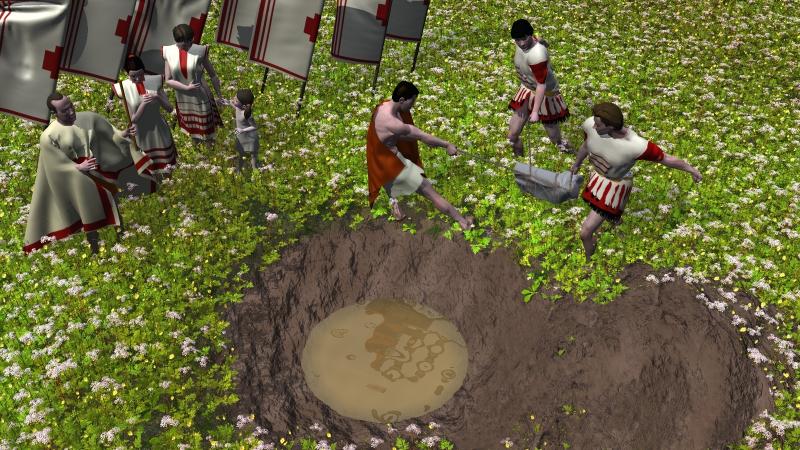
<p><a title="A lead font is submerged in a waterhole" rel="lightbox" href="https://framearch.co.uk/t5/wp-content/uploads/2007/04/roman.jpg"><img decoding="async" src="https://framearch.co.uk/t5/wp-content/uploads/2007/04/roman.thumbnail.jpg" alt="A lead font is submerged in a waterhole" /></a><br />
<span class="caption">A lead font is submerged in a waterhole</span></p>
<div style="padding: 0px 0px 0px 5px; margin: 0px 0px 0px 0px;"><img loading="lazy" decoding="async" class="noborder" usemap="#Map" src="https://framearch.co.uk/t5/wp-content/images/time-nav-master.jpg" alt="Travel in time" width="490" height="39" />&nbsp;</p>
<map id="Map" name="Map">
<area shape="rect" coords="4,0,202,32" href="https://framearch.co.uk/t5/2007/05/24/100-bc-360-ad-a-new-direction/" alt="Backwards in time to 3,000-2,000 BC" />
<area shape="rect" coords="291,2,480,30" href="https://framearch.co.uk/t5/2007/05/03/flax-farming/" alt="Forwards in time to 3,000-2,000 BC" /> </map>
</div>
<p>It cannot be demonstrated that occupation continued at Terminal 5 beyond the later 4th century AD, but it was probably at this time (<em>c</em> AD 400) that the inhabitants of the farmstead deposited the remains of a damaged lead tank into a waterhole on the floodplain to the west of the main settlement. The tank is one of a small group of Roman Christian lead tanks found only in Britain, possibly used for baptism or washing of the feet and indicates a small Christian population at the site. The placing of this object within a waterhole, perhaps especially dug for the occasion, is, nevertheless, part of a long-standing tradition of ritual deposition within watery contexts. It suggests that Christianity had absorbed aspects of earlier spiritual traditions, possibly helping the occupants to deal with the tumultuous shifts in the religious, political and social circumstances of the final days of the Roman Empire in Britain.</p>
<p>&nbsp;</p>{"id":54,"date":"2007-04-24T13:16:16","date_gmt":"2007-04-24T13:16:16","guid":{"rendered":"http:\/\/www.framearch.co.uk\/t5\/2007\/04\/24\/ad-360-3-the-lead-tank\/"},"modified":"2011-03-28T09:14:46","modified_gmt":"2011-03-28T09:14:46","slug":"ad-360-3-the-lead-tank","status":"publish","type":"post","link":"https:\/\/framearch.co.uk\/t5\/2007\/04\/24\/ad-360-3-the-lead-tank\/","title":{"rendered":"400 AD The End of an Era"},"content":{"rendered":"<p><a title=\"A lead font is submerged in a waterhole\" rel=\"lightbox\" href=\"https:\/\/framearch.co.uk\/t5\/wp-content\/uploads\/2007\/04\/roman.jpg\"><img decoding=\"async\" src=\"https:\/\/framearch.co.uk\/t5\/wp-content\/uploads\/2007\/04\/roman.thumbnail.jpg\" alt=\"A lead font is submerged in a waterhole\" \/><\/a><br \/>\n<span class=\"caption\">A lead font is submerged in a waterhole<\/span><\/p>\n<div style=\"padding: 0px 0px 0px 5px; margin: 0px 0px 0px 0px;\"><img loading=\"lazy\" decoding=\"async\" class=\"noborder\" usemap=\"#Map\" src=\"https:\/\/framearch.co.uk\/t5\/wp-content\/images\/time-nav-master.jpg\" alt=\"Travel in time\" width=\"490\" height=\"39\" \/>&nbsp;<\/p>\n<map id=\"Map\" name=\"Map\">\n<area shape=\"rect\" coords=\"4,0,202,32\" href=\"https:\/\/framearch.co.uk\/t5\/2007\/05\/24\/100-bc-360-ad-a-new-direction\/\" alt=\"Backwards in time to 3,000-2,000 BC\" \/>\n<area shape=\"rect\" coords=\"291,2,480,30\" href=\"https:\/\/framearch.co.uk\/t5\/2007\/05\/03\/flax-farming\/\" alt=\"Forwards in time to 3,000-2,000 BC\" \/> <\/map>\n<\/div>\n<p>It cannot be demonstrated that occupation continued at Terminal 5 beyond the later 4th century AD, but it was probably at this time (<em>c<\/em> AD 400) that the inhabitants of the farmstead deposited the remains of a damaged lead tank into a waterhole on the floodplain to the west of the main settlement. The tank is one of a small group of Roman Christian lead tanks found only in Britain, possibly used for baptism or washing of the feet and indicates a small Christian population at the site. The placing of this object within a waterhole, perhaps especially dug for the occasion, is, nevertheless, part of a long-standing tradition of ritual deposition within watery contexts. It suggests that Christianity had absorbed aspects of earlier spiritual traditions, possibly helping the occupants to deal with the tumultuous shifts in the religious, political and social circumstances of the final days of the Roman Empire in Britain.<\/p>\n<p>&nbsp;<\/p>","protected":false},"excerpt":{"rendered":null,"protected":false},"author":1,"featured_media":0,"comment_status":"open","ping_status":"open","sticky":false,"template":"","format":"standard","meta":{"footnotes":""},"categories":[60],"tags":[14,22,45],"_links":{"self":[{"href":"https:\/\/framearch.co.uk\/t5\/wp-json\/wp\/v2\/posts\/54"}],"collection":[{"href":"https:\/\/framearch.co.uk\/t5\/wp-json\/wp\/v2\/posts"}],"about":[{"href":"https:\/\/framearch.co.uk\/t5\/wp-json\/wp\/v2\/types\/post"}],"author":[{"embeddable":true,"href":"https:\/\/framearch.co.uk\/t5\/wp-json\/wp\/v2\/users\/1"}],"replies":[{"embeddable":true,"href":"https:\/\/framearch.co.uk\/t5\/wp-json\/wp\/v2\/comments?post=54"}],"version-history":[{"count":4,"href":"https:\/\/framearch.co.uk\/t5\/wp-json\/wp\/v2\/posts\/54\/revisions"}],"predecessor-version":[{"id":479,"href":"https:\/\/framearch.co.uk\/t5\/wp-json\/wp\/v2\/posts\/54\/revisions\/479"}],"wp:attachment":[{"href":"https:\/\/framearch.co.uk\/t5\/wp-json\/wp\/v2\/media?parent=54"}],"wp:term":[{"taxonomy":"category","embeddable":true,"href":"https:\/\/framearch.co.uk\/t5\/wp-json\/wp\/v2\/categories?post=54"},{"taxonomy":"post_tag","embeddable":true,"href":"https:\/\/framearch.co.uk\/t5\/wp-json\/wp\/v2\/tags?post=54"}],"curies":[{"name":"wp","href":"https:\/\/api.w.org\/{rel}","templated":true}]}}
